
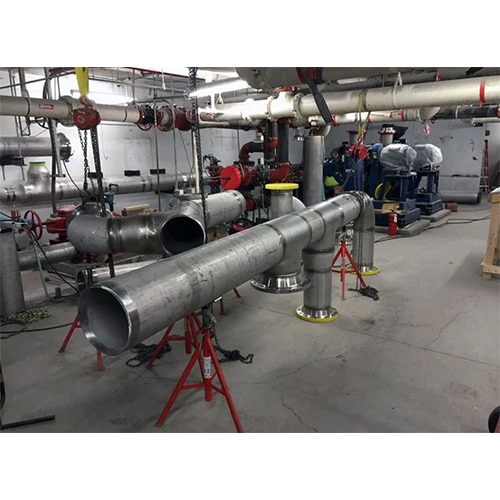
Pipeline Fabrication
Description
Piping fabrication is the precise process of cutting, beveling, bending, and welding raw pipe materials and components—such as elbows, tees, and flanges—into custom piping systems.
Engineers map out dimensions and specifications based on isometric drawings. Materials are marked and tagged with unique heat numbers for tracking.
Raw pipes are measured and cut using saws, plasma cutters, or torches. Edges are beveled to create grooves for deep weld penetration.
Fit-Up & Alignment: Components are aligned using clamps, squares, and levels, maintaining a small root gap (3-5 mm) for optimal welding. Temporary tack welds hold pieces together.
Skilled welders use methods like TIG or stick welding to permanently join sections into robust “spool” assemblies.
Assemblies undergo quality checks, including non-destructive testing (NDT) and pressure tests, to ensure zero leaks and structural integrity.
Types of Fabrication
• Shop Fabrication: Performed in a controlled workshop environment. Ideal for large butt-welded systems, modular units, and complex bends.
• Field Fabrication: Done on-site at the installation location. Generally used for small-bore pipes, threaded connections, or final tie-ins.